


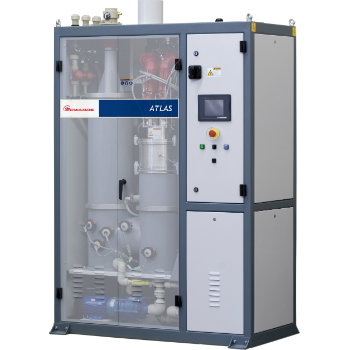
Technical data |
|
| Process gas inlets / Bypass outlet : | NW40 stainless steel |
| Abatement system exhaust outlet : | 75 mm diameter polypropylene |
| Cabinet extraction outlet : | 150 mm diameter x 150 mm deep, painted mild steel |
Atlas TCS
OverView
Effective exhaust management of CVD processes must be able to handle the deposition gases and the associated powders. The fluoride wastes from cleaning gases also require suitable treatment along with global warming gases. Abatement systems must be able to comply with these requirements in one complete unit.
The Atlas TCS provides reliable, high performance, low cost abatement of flammable and acid gases from CVD exhausts. The Atlas TCS incorporates the unique inward-fired radiant combustor and high-efficiency multi-stage water scrubber developed for the Thermal Processing range and is ideally suited to the treatment of exhaust streams from CVD tools employing remote plasma NF3 cleans and high flows of F2.
Features and Benefits
- High performance, robust abatement Capable of removing pyrophoric and acid gases to below TLV
- Safe treatment of up to 20 slpm fluorine
- Excellent powder handling capabilities
- Low cost of ownership
- Water recirculation for reduced water usage
- Full tool interfacing for utilities conservation
- OEM recommended
- Maximized tool uptime
- Low thermal mass facilitates rapid servicing
- Field proven, corrosion-resistant design
- Small footprint
- Supported by global field service organisation
- Third-party certification
- SEMI S2, F15 certified, ETL Listed
Atlas TPU
OverView
The Atlas TPU is a world proven system and the semiconductor industry's standard abatement system for CVD. In one model, there is suitability for all CVD and Etch applications, enabling World Semiconductor Council PFC emission reduction targets to be met. Each inlet can be individually configured for the highest level of abatement of all PFC gases, Fluorine (F2) or Chlorine TriFluoride (ClF3).
Features and Benefits
- Low Cost of Ownership
- Water Recirculation Unit (WRU) ensures low water usage
- Unrivalled Abatement Performance
- Independently verified
- Provides high flow, high performance, CF4 abatement
- Capable of treating high flows of ClF3
- Robust Field Performance
- Certified to SEMI S2, CE Marked and ETL Listed
Atlas Kronis
OverView
Effective exhaust management of CVD processes must be able to handle the deposition gases and the associated powders. The fluoride wastes from cleaning gases also require suitable treatment along with global warming gases. Abatement systems must be able to comply with these requirements in one complete unit.
Achieving clean combustion of low k organosilane precursors is challenging, and failure to do so results in unacceptable by-products and blockages in downstream systems. Ultimately such blockages can cause unscheduled downtime. Edwards has gained an in-depth understanding of low k CVD process issues by working extensively with OEMs and materials suppliers during process development.
Features and Benefits
- High performance abatement
- Destroys all low k CVD precursors and clean species simultaneously
- Complete reaction eliminates clogging issues
- Environmental and health and safety compliance assured
- Extensive OEM qualification program
- Low cost of ownership
- Controlled, cost-effective combustion
- Option to run on compressed dry air
- Water recirculation reduces water usage
- Maximised tool uptime
- Excellent handling of high powder volumes
- Field-proven, corrosion-resistant design for chamber cleaning gases
- Supported by Edwards’ global service team for unrivalled field reliability
- Enhanced wafer security
- PLC Controlled, tool interfacing and full system monitoring
- Third-party certification
- SEMI S2, F15 certified, ETL listed
Atlas Helios
OverView
Effective exhaust management of CVD processes must be able to handle the deposition gases and the associated powders. The fluoride wastes from cleaning gases also require suitable treatment along with global warming gases. Abatement systems must be able to comply with these requirements in one complete unit.
Features and Benefits
- Proven high abatement performance for toxic, pyrophoric & corrosive gases
- Reliable handling of associated powders
- Controlled and complete oxidation of hydrogen to safe limits
- Capable of handling up to 200 lpm of hydrogen
- Up to 4 process inlets
Atlas Etch
OverView
Abatement solution for Generation 5, 6 and 7 Flat Panel Etch Processes
Application challenges
Modern FPD (Flat Panel Display) Etch processes combine the use of large PFC gases flows (typically SF6 and/or CF4) with large flows of Chlorine (Cl2) and Hydrochloric acid (HCl). A generation 6 etch process tool will typically combine 12slm of SF6 and/or 8slm of CF4, with 15slm of Cl2 or 15slm HCl. Combustion abatement methods are faced with three challenges: the combustion of large PFC gas flows (PFCs are extremely stable chemical compounds), in the presence of large Cl2 flows (chlorine acts as a flame-suppressant), and the management of acidic by-products (HCl, HF, H2SO4 and SO2).
Atlas Etch has successfully met with all three challenges. Optimisation of the combustion process and smart management of the gas input enable destruction and removal efficiencies (DREs) greater than 99% for SF6 and greater than 90% for CF4, even in the presence of Chlorine. The use of corrosion resistant materials in the design of the wet scrubbing stages ensures that Atlas Etch can remove acidic by-products reliably whilst maintaining low water consumption and high process uptime.
Features and Benefits
- Proven high abatement performance for toxic, pyrophoric & corrosive gases
- Reliable handling of associated powders
- Controlled and complete oxidation of hydrogen to safe limits
- Capable of handling up to 200 lpm of hydrogen
- Up to 4 process inlets
Dimensions
Performance Curve
-

Vaccum Pump Selection Guide
Find Pump -

Do you have any questions?
Free Inquiry -

You can give us a call back
Request a Call


Trusted By Industry Leaders
Trusted by leading organisations across R&D, semiconductor, pharmaceutical, and industrial sectors, we deliver reliable vacuum solutions backed by decades of technical expertise.


